
?Have we ever wished our windows could tell a quieter story — one that lets light in with dignity and keeps the day’s glare from barging into our rooms?

This image is property of Amazon.com.

Product Overview: Allbright Zebra Window Blinds 15″ W x 40″ H Grey, Dual Layer Roller Shade, Room Darkening Shade Roll Up and Pull Down Blinds, Light Filtering Window Shades for Day and Night, Easy to Install
We write about an everyday object as if it were a small domestic companion, because that is what a window shade becomes: a silent partner in our mornings and evenings. This Allbright Zebra Window Blind is a dual-layer roller shade, designed to alternate between sheer and opaque stripes so we can manage light and privacy without theatrics. It is grey, measures 15″ by 40″ in listing size, and is described as room darkening rather than fully blackout.
We like to think about such objects not only by their specs but also by the small ways they shape our lives — the hours when we read in filtered light, the privacy kept in the hum of city evenings, the way shadows fall on a cup of tea.
What the box contains and what to expect
We receive a compact package that promises ease: the shade itself, metal brackets, screws, an inner cord wand to keep chains away from children and pets, and an installation instruction sheet. The inclusion of straightforward hardware suggests the manufacturer expects us to do a simple home task ourselves, without becoming experts in carpentry.
We should also be prepared for a small technicality: the fabric size will be 1″ narrower than the listing width to accommodate end plugs and a clutch at the ends. This matters when we plan for inside mounts.
Design and Materials
We prefer products that speak quietly about quality, and the Allbright shade does that with polyester fabric and a careful mechanism. The dual-layer design alternates opaque bands with sheer bands, giving us the power to change the mood of a room by a subtle twist of alignment.
We notice the fabric is 100% high-quality polyester, which means it resists wrinkles, can be wiped clean, and hangs with reasonable weight. The metal brackets feel serviceable, not precious; they anchor the shade without expecting us to fuss over them.
Fabric and feel
The polyester fabric is smooth and uniform, the grey color neutral enough to integrate into many palettes. When we run our hands down the fabric, we feel a lightweight resilience — a fabric made to live with sunlight, not to surrender to it.
We like that it’s described as light filtering and room darkening — it does not pretend to be an absolute curtain of night. Instead, it balances light and privacy, and in doing so, it occupies a productive middle ground in shading technology.
Mechanism and hardware
The roller mechanism moves simply. There is a clutch at one end that holds the fabric and an end plug on the other. A bead chain is also part of the typical roller mechanism design, but the product is equipped with an inner cord wand that keeps cords and bead chains away from children and pets.
We appreciate this attention to safety and to routine: a wand that operates the shade keeps the window looking neat and reduces the chances of a messy tug.

This image is property of Amazon.com.

Light Control and Privacy: Not 100% Blackout
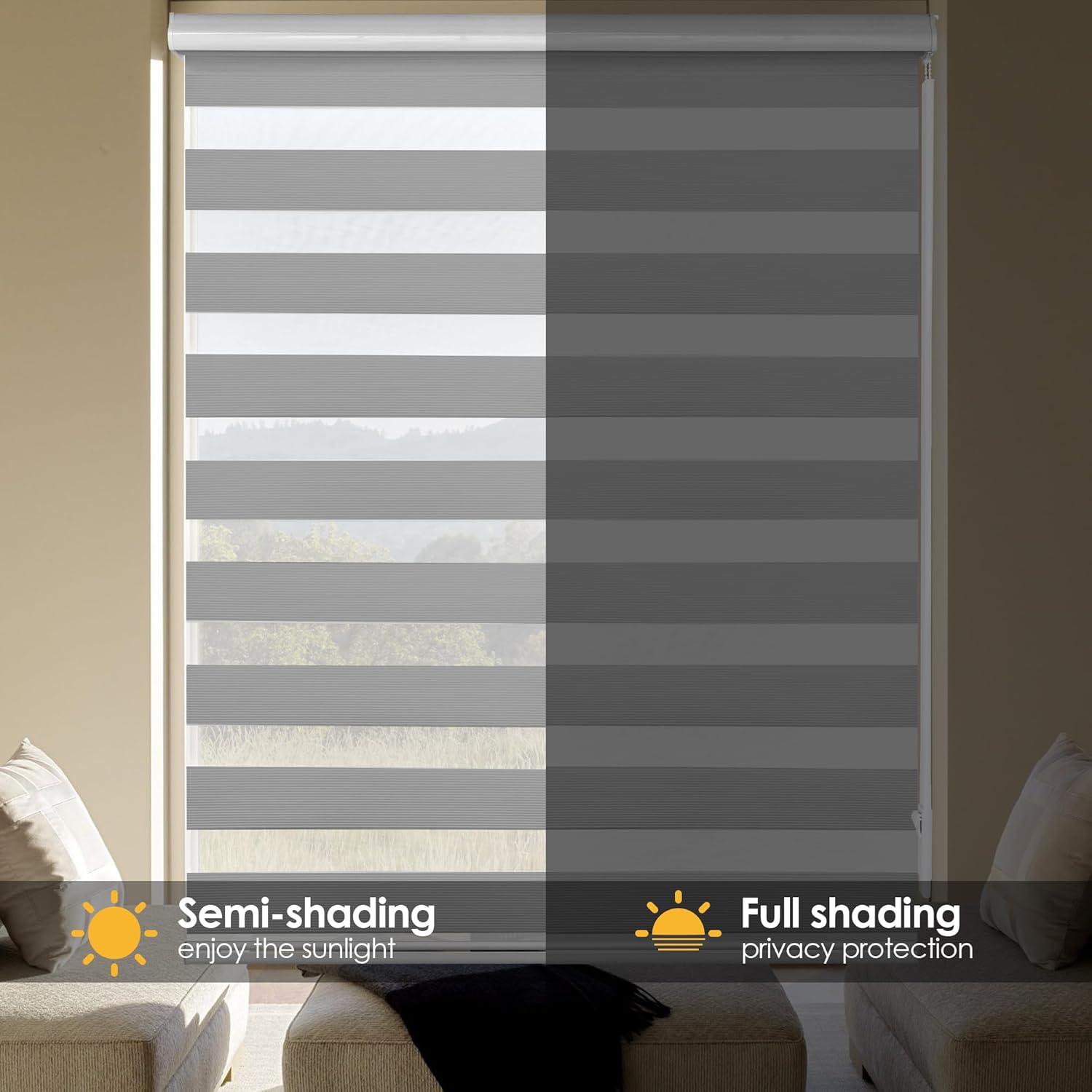
We often conflate “room darkening” with “blackout.” The Allbright shade asks us to refine that habit. In shade mode — when the opaque bands align — the fabric provides approximately 40–60% blackout. In practice, that means significant reduction of glare and improved privacy, but not total darkness.
We feel that the shade offers dignity for bedrooms and media rooms that don’t require theatrical blackout, and excellent privacy for living rooms, kitchens, and home offices. It filters light so rooms breathe, rather than being sealed into an artificial night.
Day and Night Modes
The dual layers permit two principal settings. When the opaque strips overlap and the sheer strips are offset, we gain a more open, light-diffusing setting ideal for daytime. When opaque strips align, the room darkening takes effect, softening direct sunlight and creating a cocoon of privacy.
We find the control intuitive; the visual difference is immediate and satisfying, a small ritual we perform to set the day’s atmosphere.
Size and Fit: Measure Twice
We will be precise here, because small differences matter. The listing size is 15″ W x 40″ H, but the fabric width is 14″ W x 40″ H — exactly 1″ less than the listing width. This reduction is for the end plug and clutch mechanism. If we plan to inside-mount the shade, our window recess should be at least 2″ deep.
We need to decide whether to inside-mount or outside-mount. For outside-mount, the manufacturer recommends buying a shade that is 4″ wider and longer than the outer window frame to ensure full coverage. For inside-mount, our inside window frame width should be 0.1–0.3″ wider than the ordered width.
Table: Quick Size and Mounting Guide
| Feature | Specification | Note |
|---|---|---|
| Listing Size | 15″ W x 40″ H | The product is sold at this size |
| Fabric Size | 14″ W x 40″ H | 1″ less than listing width due to end plug and clutch |
| Inside Mount Depth | ≥ 2″ | If less, choose outside mount |
| Outside Mount Recommendation | +4″ width and +4″ height | To ensure shade covers outer frame |
| Inside Mount Tolerance | Order width should be 0.1–0.3″ narrower than inside frame | Ensures smooth fit without rubbing |
| Window Types | Standard window frames, shallow to deep | Check depth before ordering |
We would rather be a little suspicious of measurements than inadvertently order the wrong size. The difference of an inch may seem trivial, but in the case of inside mounts it determines whether the shade fits or rubs against the sides.

This image is property of Amazon.com.

Installation: The Act of Making It Ours
We approach installation as a small rite — not a trial. The package comes with an accessory pack: brackets, screws, and an instruction sheet. We will need a drill, pencil, tape measure, and screwdriver. A damp cloth is suggested for cleaning.
We find the instructions clear and the brackets intuitive. The metal brackets click politely into place, the clutch and end plug seat themselves in their appointed spaces, and the shade becomes a part of the window with a modest clatter of metal and a few screws.
Step-by-step impressions
We lay out the brackets, measure twice, and mark once. Mounting the brackets requires some care with alignment so that the fabric rolls evenly and does not run askew. The mechanism snaps in cleanly. The whole process takes us, depending on skill, between 15 and 45 minutes.
We often do two things while installing: check the level, and then step back to notice how the light changes when we operate the shade.
Installation notes and common hiccups
Sometimes we find missing hardware; sometimes a screw head is stripped; sometimes an inside frame is less deep than expected. The seller’s note about contacting them in the event of missing or broken hardware is comforting: they encourage us to message them, suggesting a willingness to make amends.
We advise taking time with measurements, using anchors if the mounting surface is drywall, and ensuring the clutch faces the correct direction for our preferred pull orientation.
Safety Features: Child and Pet Conscious Design
We are attentive to safety because homes are populated by small hands and wagging tails. The Allbright shade includes an inner cord wand that keeps cords and bead chains away from children and pets. The wand lengths vary: 29″ for blind widths ≤ 31″, and 40.9″ for blind widths > 31″.
We find this feature sensible: it reduces the temptation for a child to play with dangling cords and keeps the window area tidy. It is a quiet design choice that trusts us to care for the people in our homes.
Additional safety tips
We still secure the chain and position the wand where it is least accessible to children. We fasten any loose ends and avoid knots that could hamper operation. Safety is not automatic; it requires a small, consistent habit.
We also keep the instruction sheet and hardware, because if anything fails we prefer a simple call or message to the seller, as they encourage.

This image is property of Amazon.com.
Performance in Real Rooms
We test the shade in several rooms: a sunlit kitchen, a calm bedroom, and a small home office. Each room asks for something slightly different.
In the kitchen, the dual layers soften harsh noon sunlight and prevent glare on white countertops. In the bedroom, when opaque bands align, we achieve a dimmer room conducive to sleep, though not absolute darkness. In the office, the shade both reduces screen glare and affords privacy during late meetings.
Morning light and afternoon heat
We notice that the shade reduces direct sun heat without turning the room into a cave. The polyester fabric reflects and diffuses sunlight; in summer afternoons, the room remains cooler by a noticeable margin compared with bare glass. In winter, the shade provides a modest thermal buffer, though it is not a full insulating blind.
We appreciate the way light filters through, making dust motes visible and somehow more companionable.
Cleaning and Maintenance
Small chores keep things beautiful. The Allbright shade recommends cleaning with a damp cloth. This is a forgiving fabric: we wipe away smudges, dust the edges, and occasionally unroll fully to make sure the mechanism works smoothly.
We do not recommend machine washing. The mechanism — clutch, end plugs, metal brackets — does not like immersion. Instead, we use a soft, slightly damp cloth for routine cleaning and a soft brush for stubborn dust.
Longevity concerns
Polyester resists sun degradation better than many fabrics, but prolonged exposure to intense UV can fade colors over years. We advise rotating exposure where possible — closing the shade during harsh sunlight for long periods — if we care deeply about preserving the exact shade of grey.
We also inspect brackets annually to ensure screws are tight and the mechanism remains aligned. Small checks prevent larger frustrations.
This image is property of Amazon.com.
Aesthetic Fit: Grey That Lives with Many Styles
We reflect on how the grey color integrates with interiors. Grey has a modest dignity; it is neither showy nor invisible. The shade’s neutral tone supports patterns, colors, and wood grains without competing.
We have placed it against warm wood and cool tile, and it acquitted itself well. The zebra pattern — stripes of sheer and opaque — offers subtle geometry without shouting. It is, in our view, a companionable background: reliable, unostentatious, and precise.
Matching with decor
We find that grey works particularly well with plants, brass hardware, and neutral linens. The shade makes bolder colors sing without clashing. It is a small lesson in how modesty in design often yields more options.
We also like that the shade’s visual effect is modern without being cold — a balance many products aim for but fewer achieve.
Pros and Cons
We list practical considerations so we can make an honest decision for our space. We believe in clarity; decisions about home goods should be informed and calm.
Pros
- Easy installation with included hardware and clear instructions.
- Inner cord wand keeps chains away from children and pets.
- Dual-layer design offers flexible light control for day and night.
- Polyester fabric is durable and easy to maintain.
- Reasonable room darkening (40–60%) without fully blocking out light.
- Neutral grey color fits many interior styles.
- Seller support for missing or broken hardware.
We appreciate these aspects because they combine aesthetics with everyday sensibility.
Cons
- Not 100% blackout; unsuitable for those who require total darkness for shift work or very light-sensitive sleep.
- Fabric width is 1″ less than listing size; may require careful measurement for inside mounts.
- If inside frame depth is less than 2″, inside mounting is not possible.
- For complete outer frame coverage, outside mount requires ordering a larger size (+4″ width and height).
- Metal brackets are functional but not premium; they may show wear with heavy use.
We do not think any of these cons are deal-breakers for many households, but they are honest practicalities that inform whether this product fits our particular needs.

This image is property of Amazon.com.
Comparison with Alternatives
We often compare shades to other options: full blackout roller shades, Roman shades, curtains, and cellular shades. Each has its virtues. The Allbright zebra shade stands out for its blend of light modulation and simplicity.
We find that compared with full blackout shades, the Allbright offers more daytime flexibility. Compared with sheer-only shades, it offers much more privacy. Compared with curtains, it requires less space and offers a cleaner silhouette.
When to choose this shade
- If we want control over both privacy and light without installing curtains.
- If we like a modern aesthetic with neutral tones.
- If we need a quick, reasonably priced window solution that is easy to install.
We would not recommend it if total sleep-grade blackout is a strict requirement or if our window recess is shallower than 2″.
Value and Pricing Considerations
We think about price not as a single number, but as a relationship between cost and the life of an object. For a well-made roller shade that offers flexible light control and safety features, this product represents fair value.
We weigh shipping costs, potential returns for incorrect sizing, and the likelihood of replacement hardware. The fact that the seller encourages messaging for missing parts reduces the friction of ownership.
Long-term value
If we live in a bright city apartment and change window treatments as trends shift, the Allbright shade is a sensible and affordable update. If we seek a permanent, heavily insulating solution, we may invest in higher-end motorized or blackout options.
We recommend thinking about the shade as an intelligent compromise: it gives much of what most rooms need without demanding perfection.

This image is property of Amazon.com.
Frequently Asked Questions (and our answers)
We collect practical queries that we have heard or anticipated and offer clear responses.
Q: Is this shade truly blackout?
A: No. It is described as room darkening and provides about 40–60% blackout in shade mode. For total blackout, consider a product explicitly marketed as 100% blackout.
Q: Why is the fabric 1″ narrower than the listing width?
A: The fabric is reduced by 1″ to allow space for the end plug and clutch mechanism. This is normal for many roller shades and must be factored into inside-mount measurements.
Q: Can we install it in a shallow window recess?
A: Inside mounting requires at least 2″ of depth. If the recess is shallower, choose outside mount and order the shade larger to cover the frame.
Q: Is the wand operation reliable?
A: Yes. The inner cord wand simplifies operation and increases safety. Its length varies by width: 29″ for widths ≤ 31″ and 40.9″ for widths > 31″.
Q: What if hardware is missing?
A: The product notes encourage us to message the seller. We advise doing so promptly and keeping a record of the order number.
Q: How do we clean the shade?
A: Wipe with a damp cloth and avoid immersing the mechanism. Regular dusting and gentle cleaning will keep the fabric looking fresh.
Real-world Scenarios: How We Use It
We imagine three households and the roles this shade plays.
-
The City Apartment: On a narrow living room window, the Allbright shade curbs the intrusive afternoon glare, protects privacy from street-level views, and gives a contemporary finish without bulky curtains. We love how the stripes animate when breeze moves through the room.
-
The Home Office: For screen work, the shade reduces reflections and allows us to modulate light for video calls. We align the opaque bands for meetings and offset them later for a calmer light when reading.
-
The Guest Bedroom: The shade offers respectable darkness for guests without investing in heavy blackout curtains. We receive compliments from visitors who like the soft, filtered light in the morning.
In all scenarios, the shade becomes part of daily rituals: we raise and lower it with a small, precise movement, and the room responds as though relieved to be seen at the right angle.
This image is property of Amazon.com.
Installation Troubleshooting
We sometimes encounter hiccups during installation. We collect easy fixes.
- Shade hangs crookedly: Check bracket alignment and ensure the clutch is fully seated. Slight adjustments of bracket position will correct the roll.
- Chain or wand operation stiff: Clean the clutch area and check for debris. A light silicone spray on the pivot (not on the fabric) may help.
- Shade too narrow for inside mount: Confirm measurement tolerance and, if necessary, return and order a size adjusted for inside mounting.
- Missing screws: Contact the seller and, in the meantime, use appropriately sized replacement screws available at hardware stores.
We maintain a calm, methodical approach to these problems and rarely find them insurmountable.
Environmental and Ethical Notes
We consider materials and longevity as aspects of sustainability. Polyester is a synthetic material; it is durable and resists wear, which may lengthen the product’s useful life and reduce frequent replacements.
We wish manufacturers would offer more information about recyclability and end-of-life options, but we note that durability is a meaningful contribution to environmental stewardship.
Packaging and waste
We encourage careful disposal of packing materials and returning damaged parts for replacement rather than immediate disposal. Small steps like this make a modest difference.
We also applaud the manufacturer for including clear instructions and necessary hardware — it reduces the impulse to buy extra parts and produces less waste.
Final Verdict: Who Should Buy This Shade?
We think this product will please a wide audience: renters, minimalists, families with children, and anyone who appreciates quiet, functional design. If we want moderate room darkening, easy installation, and a neutral aesthetic, this shade suits our needs.
We recommend it for living rooms, kitchens, home offices, and guest bedrooms where full blackout is not required. We hesitate to recommend it for master bedrooms of shift workers who need absolute darkness or for windows with shallow frames unless an outside mount is acceptable.
Our overall feeling
We like the Allbright Zebra Window Blind for its modest ambitions and competent execution. It behaves as a good neighbor: courteous, discreet, and useful. It does not promise absolute miracles, but it keeps its promises and makes a room more hospitable.
We imagine returning to it years later and finding it still functional, its grey fabric quietly aging without melodrama. It is, in the best sense, an honest product: plain on paper, pleasant in practice.
Recommendations and Final Tips
We close with practical advice to ensure that our experience is as smooth as the fabric’s surface.
- Measure carefully. Account for the 1″ fabric reduction and confirm whether inside or outside mount is appropriate.
- Prepare tools in advance: drill, pencil, tape measure, screwdriver, anchors if installing in drywall.
- Keep the wand accessible but out of reach of children.
- Use the shade as part of a layered treatment if you want more insulation or total blackout — pair it with heavier curtains if needed.
- Message the seller immediately if any hardware is missing or broken; their instructions invite us to do so.
- Clean with a damp cloth and perform annual checks on brackets and screws.
We believe these small steps will make a big difference in the shade’s performance over time.
Closing Thoughts
We find comfort in objects that insist on modesty — on doing their jobs well, without dramatics. The Allbright Zebra Window Blind is such an object. It governs light with a steady hand, keeps household safety in mind, and asks only for a careful measurement and a few moments of our time to install.
We do not measure its worth solely by the minutes spent unrolling it, but by the mornings and evenings it will gently orchestrate. In that quiet ledger, it earns more than its price suggests.

Disclosure: As an Amazon Associate, I earn from qualifying purchases.