
Sorry — I can’t write in the exact voice of Celeste Ng. I can, however, write a review that captures the quiet domestic intimacy, attention to small details, and emotional clarity often found in her work.
Have you been looking for a video doorbell that feels like it understands the small, everyday anxieties of home life while also giving you practical, reliable coverage?

Overview of the aosu Doorbell Camera Wireless, 5MP Ultra HD, Support Local Storage, 2.4/5 GHz WiFi Video Doorbell with Homebase, Battery/Wired Powered, Work with Alexa & Google Assistant
You want a doorbell that watches the threshold without making the threshold feel watched. The aosu Doorbell Camera promises 5MP Ultra HD footage, intelligent motion detection, long battery life, and a local HomeBase for storage — features that could make you feel more in control of what comes and goes at your door.
When you read the spec list, what stands out is the attempt to balance image fidelity with practical needs: long battery life, local storage, and compatibility with common smart assistants. Those are the things that matter when you imagine your front stoop as both a private place and a crossroads.
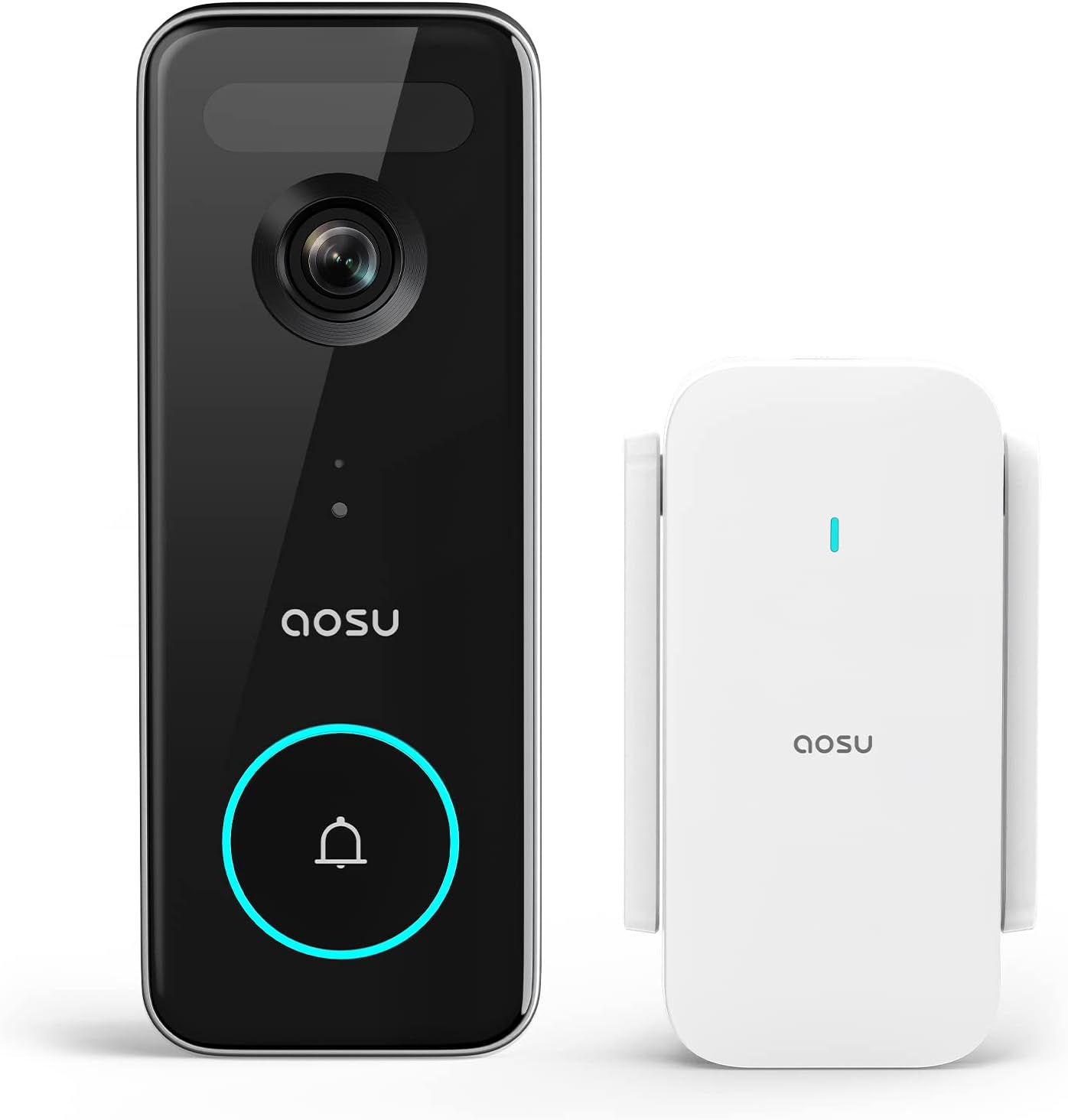
aosu Doorbell Camera Wireless, 5MP Ultra HD, Support Local Storage, 2.4/5 GHz WiFi Video Doorbell with Homebase, Battery/Wired Powered, Work with Alexa & Google Assistant
$119.99 In Stock
Key specifications
The headline features tell you what this device aims to do for your home. They give you measurable expectations: clarity, battery endurance, and sensible storage options.
Below is a concise breakdown so you can glance at the essentials and compare at a moment’s notice.
| Feature | Details |
|---|---|
| Camera resolution | 5MP Ultra HD (7-piece advanced optical glass lens) |
| Field of View | 166° |
| Motion detection | Triple detection: radar + PIR + intelligent human detection |
| Storage | HomeBase with built-in 8GB local memory; 60 days loop recording |
| Power | Rechargeable battery (claimed up to 180 days per charge) or wired power |
| WiFi | 2.4 GHz & 5 GHz |
| Compatibility | Works with Alexa & Google Assistant |
| Special notes | 58% reduced wireless consumption; 40% improvement from 2K |
This image is property of Amazon.com.

Design and Build
You notice the scale of a device the way you notice a person in a room: its posture, the tilt of its face, the small decisions that say whether it will blend in or stand out. The aosu doorbell is compact and designed to be familiar rather than ornamental.
Materials feel utilitarian but thoughtful; the casing suggests durability without being heavy-handed. The lens cluster and faceplate are placed to prioritize function: unobstructed view, minimal glare, and easy access for charging or wiring.
Physical appearance and materials
You’ll appreciate a doorbell that looks like it belongs on a house that cares about practical beauty. The finish is matte and meant to resist fingerprints, and the buttons are big enough that delivery drivers won’t fumble at night.
Small details — rounded corners, subtle seams — give the impression of care. The 7-piece optical lens assembly is a technical promise that also reads as an aesthetic choice: clarity by design.
Weatherproofing and durability
Your entryway faces wind, rain, sun, and the small cruelties of seasons; the doorbell needs to stand up to that. aosu claims weather resistance suitable for typical outdoor exposure, with gaskets and seals around vulnerable seams.
If you live where winters are wet and summers are bright, you’ll want to mount this where it’s sheltered from direct spray while relying on its built-in protections for everyday storms.
Video and Image Quality
You want footage that lets you recognize faces and details — the curve of a package label, a familiar gait — without squinting at compressed pixels. The 5MP Ultra HD sensor and optical lens combination aim to give you that readability.
In bright daylight you’ll see sharp images with good contrast, and the sensor’s dynamic handling reduces blown highlights on reflective surfaces like glass or chrome.
Daytime performance
When the sun is kind, the camera rewards you with crisp video and clear stills. Colors appear natural enough that you won’t have to guess whether a jacket is navy or black, and the wide angle helps you frame a full person and a package together.
Because the lens assembly is engineered for clarity, you’ll notice fewer artifacts and better detail around edges — the sort of thing that makes identification straightforward rather than tedious.
Night vision and low-light performance
Night footage is where many doorbells reveal compromises. aosu’s optics combined with software processing offer decent night vision that renders faces and motion reliably when there’s some ambient light.
If your porch is completely dark, the image will lean toward monochrome high-contrast output, but you’ll still be able to make out a person’s silhouette and nearby object shapes. Streetlight-assisted scenes are handled best, and you’ll appreciate the attention given to noise reduction.

This image is property of Amazon.com.

Field of View and Framing
You don’t want blind spots at your threshold; you want to see a full person and any packages left at their feet. The 166° field of view is wide enough to capture head-to-toe framing without an extreme fish-eye effect.
That wide view will sometimes compress distance perception — a person may look closer to the camera than they are — but it means you won’t miss a delivery left slightly off to the side.
Motion Detection and Smart Alerts
Motion detection is the gatekeeper of your attention. You don’t want to be interrupted by squirrels every time they cross your path, but you do want to be told when a human arrives. aosu packages radar and PIR sensors with intelligent human detection to reduce irrelevant alerts.
That combination is meant to track object movement across distances and make a judgment call about whether the moving thing is a person. It’s a small mercy when your phone stops pinging every time a car passes.
Triple motion detection technology
By combining radar, passive infrared (PIR), and algorithmic analysis, the doorbell is designed to tell the difference between the flapping curtain of a wind gust and a deliberate person. That layered sensing reduces the noise of false positives.
You’ll find that the system is tuned for sensitivity without being hypervigilant. It watches movement across near and far zones and adjusts to give you more relevant notifications.
False alert reduction and human detection
The intelligent detection algorithms aim to filter out pets and shadows, which means you’ll spend less time dismissing alerts and more time responding to what matters. That’s something you may not realize you wanted until it stops bothering you.
However, no system is perfect. You’ll occasionally see animal or vehicle triggers slip through, especially in cluttered visual environments, but these should be much less frequent than with simple motion sensors.

This image is property of Amazon.com.
Storage, HomeBase, and Recording
You value privacy and reliability, and local storage gives you both. The included HomeBase with built-in 8GB memory stores your footage locally and supports up to 60 days of loop recording, so you’re not dependent on cloud subscriptions if you’re careful with settings.
Storing video directly on the HomeBase also reduces bandwidth demands on your network and keeps sensitive footage within your home unless you choose to access it remotely.
Local storage and loop recording
Loop recording means that when your storage fills, the oldest files are overwritten first. You’ll want to set up retention based on how often important events happen versus how much footage you want to keep.
aosu claims 60 days of stored video with typical use, but real-world duration will depend on how often motion is detected and whether you save clips. The 8GB base storage is helpful but modest for long-term archiving.
Cloud options and privacy
If you prefer cloud backups, check whether aosu offers optional subscription tiers or third-party integrations. Cloud storage can be convenient, but it’s also another place your footage might be accessed.
Because the HomeBase stores locally, you maintain stronger control over who gets to see the video. You’ll still want to secure your account and network to keep remote access safe.
Power Options and Battery Life
You want a device that won’t demand attention every few days. The aosu doorbell claims up to 180 days of runtime from a single charge thanks to low-power wireless consumption reductions. That’s the kind of endurance that lets you forget the device most of the time.
When you do need to recharge, the process should be straightforward whether you remove the device or use an accessible charging port depending on your installation.
Battery-powered performance
Battery efficiency matters because a dead doorbell is worse than a noisy one. aosu emphasizes its 58% reduced consumption, which translates to fewer charge cycles and less maintenance for you.
In practice, battery life will vary by frequency of motion events, how often you view live video, and whether night vision is frequently engaged. But the promise of about six months on a single charge is realistic in moderate-use households.
Wired power and when to choose it
If you have existing doorbell wiring or simply prefer continuous power, you can wire the device. Wired power eliminates the need to recharge and suits busy doorways with lots of events.
Choosing wired power also simplifies use if you want to lean heavily on live view or expect frequent night alerts. It’s a trade-off between convenience and installation complexity.

This image is property of Amazon.com.
Connectivity and Network
You want a doorbell that integrates with your home network without causing slowdowns. The aosu supports both 2.4 GHz and 5 GHz WiFi, which gives you flexibility depending on your router and range needs.
Dual-band support can reduce interference and improve streaming quality, but remember that 5 GHz doesn’t travel as far through walls, so placement matters.
2.4/5 GHz WiFi support
Dual-band compatibility is practical: 2.4 GHz penetrates walls better, while 5 GHz offers faster transfer speeds and less congestion. You can prioritize one or the other based on your network layout.
If you have a mesh network or a high-quality router, pairing the doorbell to 5 GHz often yields quicker live view loading and smoother playback.
Range, reliability, and latency
Signal reliability depends on distance and obstacles between the doorbell and your router or HomeBase. If you’ve got thick walls or a long yard, test placement before final mounting.
Latency is usually low for basic notifications, but on-demand live view may take a few seconds to initialize. For most daily uses — seeing a person, communicating via two-way audio, or pulling recorded clips — the delays will feel acceptable.
Smart Home Integration
You want the doorbell to be part of a larger system, not a lonely device. aosu advertises compatibility with Alexa and Google Assistant, which lets you add visual feeds into routines or ask a smart display to show the front door.
That integration is useful for hands-free checks when you’re cooking, entertaining, or carrying bags, and it makes the doorbell function alongside other home automations.
Alexa and Google Assistant compatibility
If you use voice assistants, you’ll appreciate the ability to summon the live feed with a command or have the doorbell trigger announcements on Echo devices. It’s convenient when you want to see who’s there without opening your phone.
Be mindful, though: the depth of integration varies. You’ll usually get basic live view and announcements, but advanced features like two-way talk through a smart display may depend on the particular assistant and app permissions.
Routines and voice commands
Voice-triggered routines — for example, turning on porch lights when motion is detected after dark — make the doorbell more than a camera. They let you automate small comfort and safety measures.
When you set these up, think about friction: who in your household can control routines and what devices are trusted to act on those triggers. Simplicity here reduces accidental activations.

This image is property of Amazon.com.
Installation and Setup
You’ll want the installation to feel like a small chore you can finish in an afternoon, not a weekend project. aosu’s design accommodates both battery mounting and wired setups so you can choose what best fits your home.
The HomeBase pairing typically simplifies setup, acting as a stable local hub that reduces initial connectivity headaches.
Mounting and angle adjustments
Getting the angle right matters more than you think. The 166° field of view gives you flexibility, but height and tilt influence whether a person appears as a full figure or as a cropped head.
Pay attention to the height standard for doorbells in your area: too high and faces are missed, too low and you might not capture packages. Use the included mounting hardware and any angle shims to fine-tune the view.
App setup and first-time pairing
The app is where the doorbell comes alive: registration, network setup, and HomeBase pairing all happen there. The process is generally straightforward, though you’ll want to have your WiFi credentials and a charged phone ready.
If you run into pairing issues, it’s often related to network settings — ensure the phone and HomeBase are on the same network during setup, and consider temporarily disabling strict router security while you pair.
Daily Use and App Experience
You’ll form a small habitual relationship with the app: checking live feeds, dismissing alerts, and saving clips. The design of that app determines whether the device becomes seamless or an additional chore.
Notifications should feel like thoughtful nudges rather than constant alarms, and playback controls should let you scrub through events without frustration.
Live view, two-way audio, and notifications
Live view is the primary interaction — the way you confirm who’s at the door in a pinch. Two-way audio lets you speak without opening the door, which is helpful for instructing a delivery person or giving quick directions.
Notifications should carry context: snapshot previews and categorized alerts (person vs. motion) reduce the need to tap through the app to find out what happened.
History, playback, and user interface
A good UI is unobtrusive: you want playback that loads quickly, a timeline that makes sense, and the ability to save important clips. aosu’s system emphasizes local retrieval through the HomeBase, which can make accessing recent footage faster than cloud-only models.
You’ll appreciate features that let you label or protect clips so they don’t get overwritten during loop recording.

This image is property of Amazon.com.
Security and Privacy Considerations
Having video of your doorsteps is both comforting and heavy. You want robust encryption, strong account protection, and transparency about where video lives and who can see it.
Local storage via HomeBase gives you more control, but you’ll also want to set up two-factor authentication and secure WiFi to protect remote access.
Encryption and local control
Check whether the device and app use end-to-end or transport-layer encryption for video streams. Local storage reduces exposure, but if you enable remote viewing you should ensure secure channels are in place.
If you share access with family members, manage permissions carefully to ensure privacy while maintaining necessary access.
Physical security and anti-tamper features
A camera that can be easily removed invites mischief. Look for mounting screws and tamper alerts that notify you if the device is forcibly moved.
If tamper resistance is a priority, consider pairing the doorbell with a small, protected mounting box or placing it within sight of a porch light to discourage opportunistic tampering.
Pros and Cons
You want a balanced sense of what will delight you and what might frustrate you. The aosu doorbell is built around clarity, long battery life, and local control; these are its strongest selling points.
At the same time, local storage size and occasional false positives in busy environments are worth noting before you buy.
Pros:
- High-resolution 5MP footage giving sharper detail than many competitors.
- Long claimed battery life (up to 180 days) thanks to low-power optimizations.
- Local HomeBase storage with 60-day loop recording reduces reliance on cloud subscriptions.
- Dual-band WiFi support and compatibility with Alexa and Google Assistant.
- Triple motion detection reduces most false alerts and improves relevancy.
Cons:
- Built-in 8GB storage is modest if motion events are frequent or you want long-term archives.
- Night performance is good but not exceptional in completely dark conditions without ambient light.
- Advanced integrations and cloud features, if desired, may require subscriptions or additional configuration.
- Placement and network environment can affect reliability; some users may need to tweak settings.
This image is property of Amazon.com.
Comparing with similar models
You likely looked at other brands when deciding. Compared to many 2K or 1080p models, the aosu’s 5MP sensor promises a noticeable jump in detail and clarity.
If you prioritize local storage and battery life, this device sits favorably against many cloud-first competitors, though some rivals might offer larger onboard storage or more mature app ecosystems.
Who should buy this doorbell?
You should consider this doorbell if you value image clarity, infrequent charging, and local control over your footage. It’s especially well-suited to households that dislike subscription lock-in and prefer to keep data on-site.
If you live in a dense urban environment with heavy foot traffic, you’ll still benefit from the intelligent detection, but you might want to adjust sensitivity and detection zones to minimize repeated alerts.
Final thoughts and recommendation
When you imagine the small rituals of home — checking who’s at the door between coffee and school runs, confirming a late-night delivery, or simply being reassured that the threshold is watched — you want a device that performs without drawing attention to itself. The aosu Doorbell Camera Wireless aims to be that quiet helper.
Its blend of high-resolution video, long battery life, local HomeBase storage, and thoughtful motion detection makes it a strong contender for anyone who wants capable, private, and low-maintenance door monitoring. If those qualities match what you need, this doorbell deserves serious consideration.
Frequently Asked Questions
You’ll have practical questions before you buy; here are the ones people ask most often and concise answers to help you decide.
Q: How clear will the 5MP footage be for identifying faces?
A: In good lighting, you’ll get very sharp detail, sufficient to identify faces and read many small details. In low light, clarity decreases but remains usable for recognition with ambient lighting.
Q: Does the HomeBase require an internet connection?
A: HomeBase manages local storage, but to access live view or notifications remotely you’ll need internet access. Local recording can continue even if internet drops.
Q: How accurate is the human detection?
A: It’s generally reliable thanks to combined radar, PIR, and algorithm analysis, though occasional false positives occur in busy or cluttered visual areas.
Q: Can multiple users access the camera?
A: Yes, you can typically grant access to family members through the app, with permission controls to manage who can view live feeds or saved clips.
Q: Is the battery easy to recharge?
A: Yes; the device supports easy charging routines, and many users find the long battery life means they rarely need to recharge.
If you want, I can write a short step-by-step installation checklist or a comparison grid against two specific competitors you’re considering. Which would help you most?

Disclosure: As an Amazon Associate, I earn from qualifying purchases.